Insights / Claude for Small Business closed the integration gap - but o…
Claude for Small Business closed the integration gap - but only incrementally

Alice B
Mid-May, Anthropic embedded Claude directly into QuickBooks, PayPal, HubSpot, Canva, DocuSign, Google Workspace, and Microsoft 365, packaging workflows for payroll, invoicing, sales, design, marketing, and month-end close. The internet spent the weekend losing its mind about the new Claude for Small Business.
Claude for Small Business is good. It removes a real barrier. And it isn't the thing that's going to compound for you.
That's not a swipe at the product. The integration tax - the friction between the model and the seven tools small businesses actually run their operations on - has been the primary blocker on AI adoption for years. Not the model. The gap between the model and everything else. Claude for Small Business closes that gap, in production, with the tools you're already paying for.
If you've spent any time copy-pasting from a chat window into QuickBooks, you already feel the relief.
But here's the pattern you'll see over the next twelve weeks: founders install it. The dashboard lights up. The "AI applied to payroll" demo lands in the all-hands. Three months in, someone notices that nothing about how the business actually works has changed. The numbers are the same. The follow-up still doesn't happen. The pricing still hasn't moved. The Tuesday afternoon problem is still the Tuesday afternoon problem.
A prebuilt vertical is the lowest common denominator workflow for every business in its category, optimized for none of them
Why? Because a prebuilt vertical is the lowest common denominator workflow for every business in its category, optimized for none of them. The QuickBooks workflow Claude runs for an accounting firm in Salt Lake City and the QuickBooks workflow it runs for a candlemaker in Margate are the same workflow. That's the whole point of packaging it, and it's also the whole limit.
The work that compounds in your business is specific to your business. A packaged template can't carry that specificity. It can do payroll. It can't do payroll the way you do it, with the contractor exceptions you've never written down and the timing quirk you live with because Stripe and your bank don't agree on what day it is. The real power isn't the model doing your payroll; it's the model knowing how you do payroll, why you decided to do it that way, and what you'd change if you had a free hour to think about it.
That requires a context layer Anthropic isn't going to build for you. It's not a model problem: it's an operations problem wearing a model costume.
The engine and the operating system are not the same thing
Claude for Small Business can run the tasks. The connective tissue around the tasks is the operating system: who runs what, when, on whose data, in whose voice, against which goal. The model is the engine. The operating system is everything that decides what the engine works on, in what order, with what context.
Anthropic ships the engine. The operating system is your job.
That's not a complaint; it's the deal. The same was true of the iPhone, the spreadsheet, and Stripe. Each one was a step-change in capability that, on its own, didn't change the operating model of a business. The companies that compounded around them did the unglamorous middle work: deciding which workflows ran where, who owned them, what data fed them, and what "done" looked like.
Pricing is one of twenty-two levers in the commercial layer. So is distribution. So is onboarding, retention, and pipeline hygiene. Claude for Small Business makes the engine faster on each one; it doesn't tell you which lever moves the number next month.
Two things to do this week, before the novelty wears off
The first is to take the workflows the packaged templates cover and write down what's specific to you in each one. Perhaps that's the payroll exception you'd be embarrassed to explain to your accountant, or the invoicing rule that's actually three in a trenchcoat, or the HubSpot stage definitions you've been meaning to fix since you raised the seed. Plain text, no formatting, no system. That document is the start of your context layer. Anthropic can't ship it because it's not theirs to ship.
The second is to pick the lever. Not "where can AI help" - that question goes nowhere, because the answer is everywhere, which means nowhere first. Pick one lever in your commercials that's moving the number this quarter and ask three questions about it: what part of the work can the model take, what part do you keep, and what part do you actually need to redesign before the engine touches it? Most businesses skip the third question and then wonder why the model made the broken process faster.
The dormant commercial layer, made visible
The commercial layer of most small businesses is dormant: built once at incorporation, then frozen, then quietly performing for the deck while the business runs on muscle memory. A great packaged AI product arriving into that layer makes the dormancy more visible, not less.
The businesses that move forward in the next year are the ones that treat Claude for Small Business as the start of the build, not the end. The packaged workflow is the prompt. The operating system you build around it is the work.
You don't need a different model. You need to know what you'd want the model to do - in your business, with your data, in your voice, against which lever, on what cadence. That's the operating system. Build that, and the engine has somewhere to go.
Frequently asked questions
What is Claude for Small Business?
Claude for Small Business is Anthropic's mid-2026 integration that embeds Claude directly into QuickBooks, PayPal, HubSpot, Canva, DocuSign, Google Workspace, and Microsoft 365. It delivers packaged AI workflows for payroll, invoicing, sales, marketing, and month-end close, removing the integration work that had been the primary barrier to AI adoption inside small businesses for two years.
What's the difference between an AI workflow and an AI operating system?
An AI workflow is a packaged, repeatable process a model can run on your behalf - processing invoices, running payroll, summarizing pipeline. An AI operating system is the layer that decides what the model works on, in what order, with what context, and against which business goal. Prebuilt workflows are standardized across every business in a category; an operating system is specific to how your business actually works, with your contractor exceptions, your pricing logic, and your data.
Why don't prebuilt AI verticals compound for most businesses?
Prebuilt AI verticals are the lowest common denominator workflow for every business in a category, optimized for none of them. The QuickBooks workflow Claude runs for one type of business is the same workflow it runs for any other. The work that compounds is specific to your business - your exceptions, your quirks, your undocumented logic. A packaged template can't carry that specificity, so the output is faster execution of a generic process, not a better version of yours.
What is the integration tax in AI adoption?
The integration tax is the friction between an AI model and the tools a business already uses. For two years, this gap - not the model's capability - was the primary reason small businesses couldn't adopt AI in production. Copy-pasting from a chat window into QuickBooks is the integration tax in its most visible form. Claude for Small Business eliminates it by embedding AI directly into the tools small businesses already pay for.
What is the commercial layer?
The commercial layer is the system of pricing, positioning, distribution, ops infrastructure, and the other levers that turn a working product into a working business. It includes twenty-two discrete levers across external (customer-facing) and internal (operations-facing) domains. In most early-stage businesses, the commercial layer is dormant: built once at incorporation, then frozen, then quietly performing for the pitch deck while the business runs on muscle memory.
What should founders do after adopting Claude for Small Business?
Two moves before the novelty wears off. First, document what's specific to your business in each workflow the packaged templates cover: the contractor exceptions, the invoicing rules, the CRM stage logic that's been on the to-do list since the seed round. That document is the start of your context layer. Second, pick one lever in the commercial layer that's moving the number this quarter and ask three questions: what part of the work can the model take, what part do you keep, and what part needs redesigning before the model touches it.
Keep reading
Claude Opus 4.7: What It Means for Founders
Claude Opus 4.7 checks its own work and follows instructions precisely, so you can trust it with real multi-step business workflows
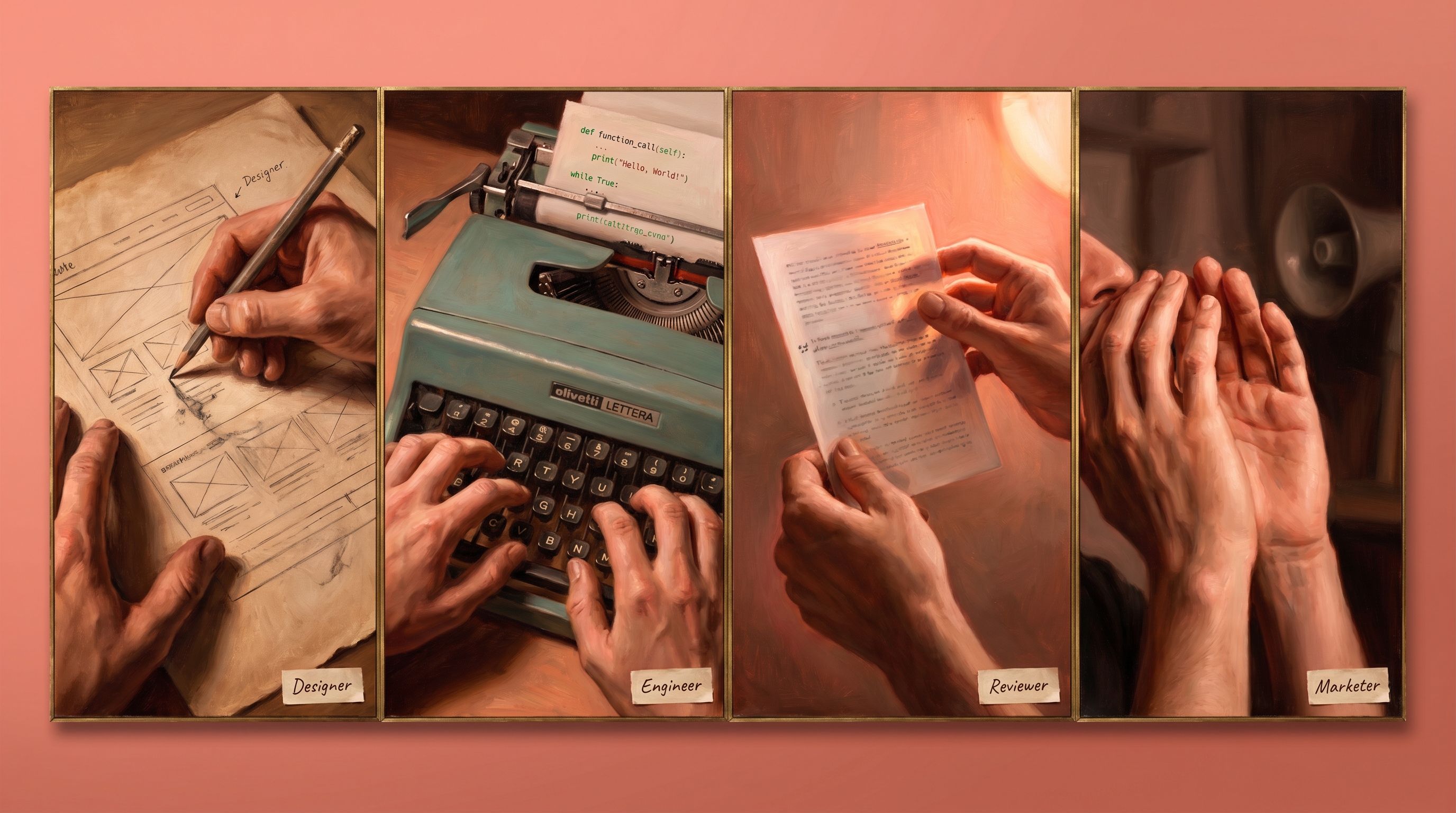
How To Run a Four-Agent Dev Team as a Non-Technical Founder
A four-agent team (Designer, Engineer, Reviewer, Marketer) that hands work between each other inside one Claude Code conversation. A non-technical founder can ship a production website, including the headless CMS install, by filling in four context files and giving briefs. Tinctu.re was built this way.

You Don't Rank on Google, You Get Cited by Claude: Generative Engine Optimization
Write one specific, quotable page answering a real buyer question. Publish it anywhere crawlable. Check whether Claude cites you 48 hours later. Repeat weekly.