Tincture OS · the AI operator for product builders · launching Summer 26

You build the product. We find your users.

You shipped something good; what nobody handed you is the part that comes after. Tincture OS tells you where your first ten users are, drafts what reaches them in your voice, and runs the plan for you, from shipped to used.

Early access opens in waves, and the list goes first.

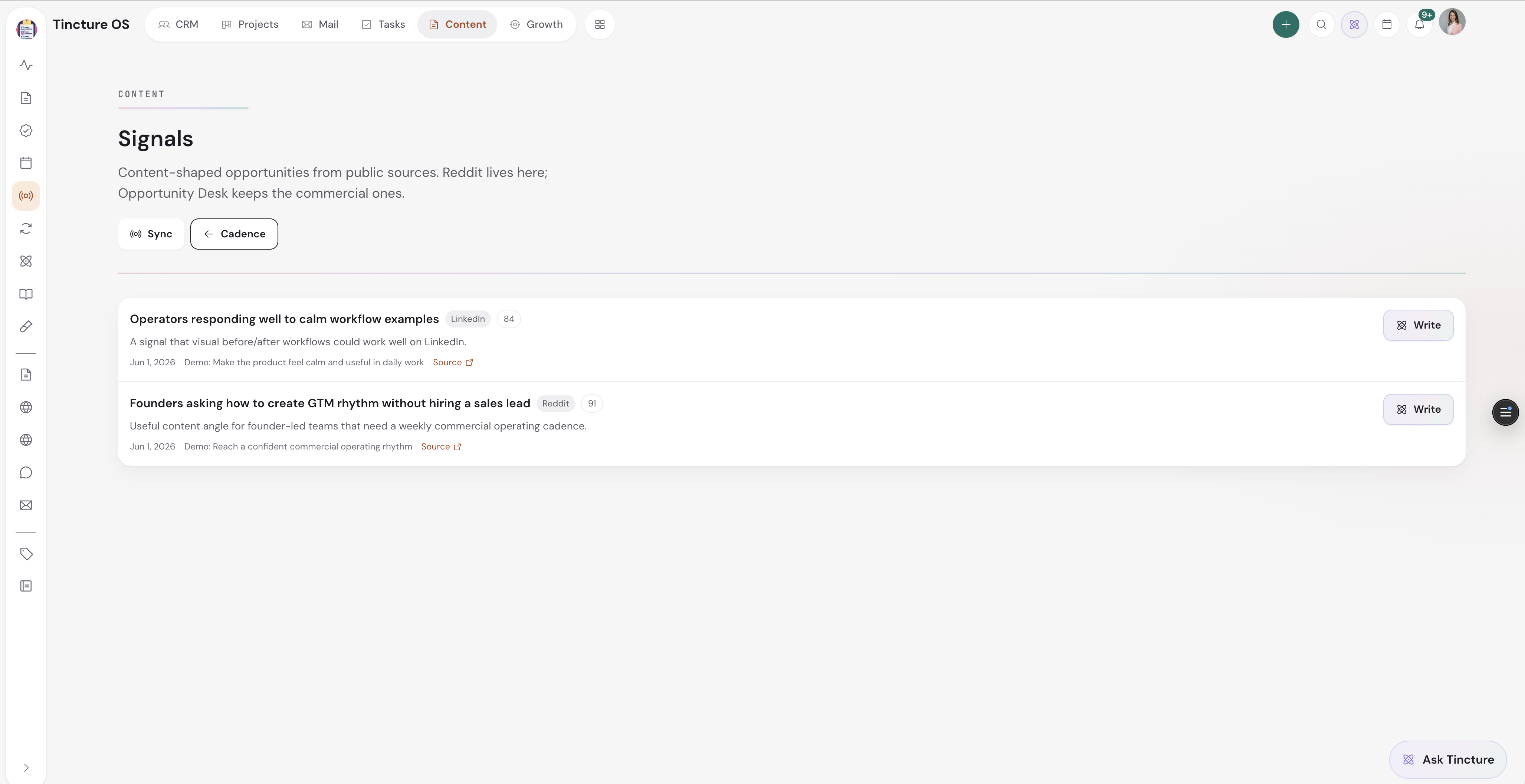
Signals
Tincture OS Signals: content opportunities surfaced from public sources

Tincture OS is the commercial operating system for builders.

The part that turns a shipped product into a business: your users, your message, your plan, all in one place that does the work for you.

How it works

Three questions in,
a working plan out.

Tincture's AI interviews you the way an operator would: what you built, who you think it's for, the hours you've actually got, and the channels you'd rather die than touch. (A channel you'll hate is a channel you'll quit.) Then the agents go to work:

  • Maps your competitors: how they position, what they charge, where they're weak.

  • Names the gap you fill, in one sentence a stranger acts on.

  • Picks the people who'll get value fastest, and finds the rooms they already gather in.

  • Builds the channel plan: what each room tolerates, what to post, when to show up.

  • Drafts the tweets, the posts, and the cold emails in your voice, with the addresses found and verified.

  • Listens while you build: when a conversation worth joining starts in one of your rooms, it flags it, so you arrive as an answer, not an ad.

Add suggested tasks
Quick add notes, tasks, ideas

The difference

Everyone else stops at the research.

Tincture turns it into your next ninety days: a plan laddered to the one goal you set, run for you one move at a time. It doesn't coach; it states the next move, does the work, and asks for your yes before anything goes out under your name.

Each step is a real agent run, not a chat reply; open any of them and see what it read, what it concluded, and why.

It learns

Most AI advice dies in the chat that produced it. Yours lives in the OS: every answer you give, every draft you correct, every move that lands updates the strategy underneath, so your positioning, your audience picks, and your channel reads stay current, tight, and effective as the business grows. It doesn't just advise; it learns.

That enduring context is the part similar tools miss: one living record of your strategy, your voice, and what's actually worked, read by every agent before it acts. Month three is sharper than week one, because nothing you've taught it gets thrown away.

The Diagnosis

Start with an operator's read on what you built.

Drop your URL and one line about what it does. Tincture reads what you've shipped and sends back the read an operator would give you: what's genuinely different about it, who'll get value from it fastest, and where those people already gather. That read is page one of your go-to-market roadmap; everything else on this page runs off it.

Your URL, one line, your email. The read lands as your early-access welcome.

Tell us about it

Your read lands here, and as your early-access welcome.

Your first read

Your first read appears here, who it's for, where your first ten users are, and your edge.

The shape of it

Everyone talks about building. Nobody talks about what comes after.

It's never been easier to build a product. It's never been harder to sell one.

01

They never taught you to sell.

You learned to build, and nobody sat you down for the rest: finding an ICP, niching to a beachhead, writing the launch post that doesn't die at four upvotes (one of them your co-founder). So the go-to-market keeps sliding, because building feels like progress and selling feels like rejection.

02

The stack was built for someone else.

Apollo, La Growth Machine, Attio, Mailchimp, and a folder of half-read research; every one designed for a sales team of forty, and you're running all of them alone on hope and an LLM brainstorm. The tools that promised to help are the thing drowning you.

03

The plan and the day never meet.

Claude wrote you an outreach-strategy.md with two non-promo subreddits and a launch-day checklist. Your day lives in a Linear board and an inbox, and nothing connects the two; you're busy every hour, and never on the thing that moves the needle.

04

You've done the hard part already.

You built something people want. What's left is showing them, one deliberate step at a time, and that's the part Tincture OS runs for you.

Onboarding

One calm home

One calm home, not eleven open tabs.

The Apollo trial, the Mailchimp you're a little scared of, the research doc you abandoned: Tincture is one home that does what they were all supposed to, with the strategy built in. And underneath the plan sits the rest of the business, ready for the users to land in: CRM, mail, projects, money, content, all connected, so a won deal becomes a project without retyping a word.

Already living in Notion? It's one click to move in. (The integration runs one way, on purpose.)

apollo logomailchimp logoattio logonotion logoclay logohubspot logoinstantly logobuffer logomonday logoquickbooks logotypefully logoclickup logo

The method

The method behind the model.

From Alice, founder of Tincture

Hi, I'm Alice.

For eighteen years I've been the operator founders bring in when a good product still isn't selling: the creator who couldn't price her own work, the dev tool whose site spoke to engineers instead of the people with the budget, the founder who knew every tactic and still couldn't tell which one to do on a Tuesday.

Every one of those engagements ran on the same method: diagnose what's actually in the way, then fix it in the right order. That method is now the operating logic of Tincture's AI; it diagnoses your product before it plans a thing, so what you get isn't a model's best guess. It's the tried and true method I implemented, by hand, productized.

I built it because I needed it for my own company first, and I'm running this entire launch on it, in public.

You stay in the loop until you decide you don't have to be: See how it thinks, let it Try small things, Tune what comes back, then Trust it with the keys, one job at a time.

The early list gets founder pricing

Be first in when it opens.

If you've shipped something good and the world hasn't noticed yet, you're who it's for. Early access opens in waves; the list gets the first invites and founder pricing that won't come back.

One email when we launch, maybe two before. No drip sequence.